
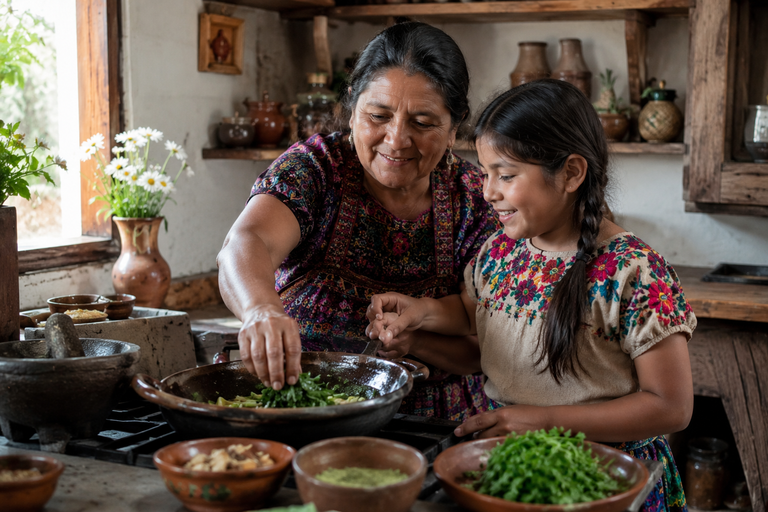
Culture does not survive only in monuments, museums, or history books. It survives in the hands, voices, memories, rituals, and everyday choices of women who carry it forward.
Culture is often described through its most visible symbols.
Architecture. Music. Clothing. Literature. Religious institutions. National celebrations. Works of art preserved behind glass.
These expressions matter, but they represent only part of the story.
Culture also lives in quieter places.
It lives in the recipe prepared without written instructions because a woman learned it by watching her mother. It lives in the language spoken to a child at bedtime, the song remembered from another country, the table arranged for a holiday, and the garment carefully stored for the next generation.
It lives in the way a grandmother welcomes guests.
In the stories an aunt repeats so younger relatives will understand where the family came from.
In the names parents choose for their children.
In the values women preserve, reinterpret, question, and sometimes courageously leave behind.
Across history, women have frequently served as the private guardians of cultural memory. Their work may not have been officially documented, but entire traditions survived because women practiced them repeatedly within homes, families, neighborhoods, and communities.
Culture remains alive because someone chooses to remember.
Very often, that person is a woman.
Culture Is Carried Through Ordinary Life
The preservation of culture rarely looks dramatic.
It may appear as a mother teaching her daughter how to prepare a traditional dish. A woman explaining the meaning of a family celebration. A grandmother correcting the pronunciation of a word from the language of her childhood.
These moments may seem domestic or ordinary, but they perform an essential cultural function.
They connect one generation to another.
A child who learns why a particular food is prepared on a certain day receives more than a recipe. She receives history, symbolism, and a sense of belonging.
A young woman who wears an inherited piece of jewelry carries more than an object. She carries the memory of the woman who once wore it and the circumstances through which it survived.
Culture becomes durable when it enters daily life.
Traditions that remain only ceremonial may gradually feel distant. Traditions practiced through conversation, hospitality, food, music, storytelling, and care become part of identity.
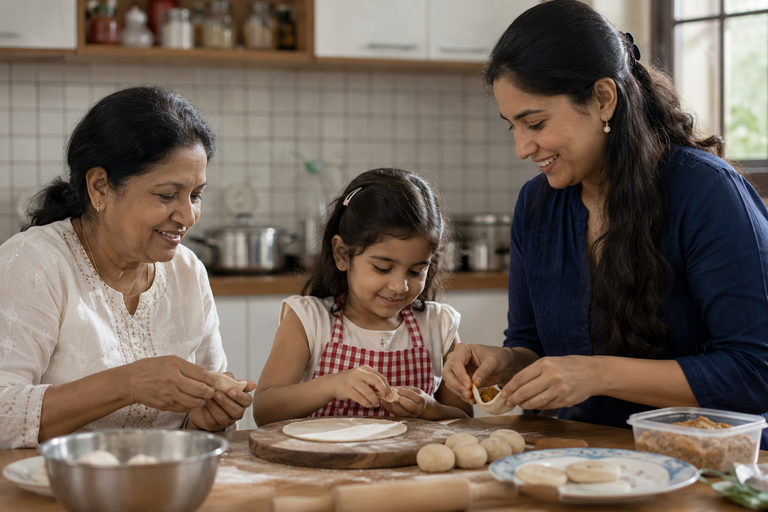
The Women Behind the Traditions
Many traditions are publicly associated with institutions, communities, or nations, yet their continuation often depends upon invisible labor.
Someone plans the gathering.
Someone remembers the details.
Someone teaches the children what to say, wear, prepare, or bring.
Someone protects the family photographs, recipes, textiles, letters, and heirlooms.
Someone notices when a tradition is beginning to disappear.
Women have often performed this work without being recognized as historians, archivists, educators, or cultural leaders.
But that is precisely what many of them are.
A woman who records an elder’s memories is preserving oral history.
A mother teaching a heritage language is protecting a cultural archive.
An artist reviving traditional craftsmanship is connecting beauty with memory.
A community organizer creating a cultural festival is building public continuity.
A writer documenting women’s experiences is correcting the historical record.
Cultural preservation is not passive nostalgia.
It is active leadership.
Language as an Inheritance
Language is among the most powerful forms of cultural belonging.
It carries humor, emotion, rhythm, worldview, and meanings that may not translate perfectly into another language.
For immigrant families, language can become both a bridge and a source of tension.
Parents may want children to speak the dominant language fluently so they can succeed without difficulty. At the same time, they may fear losing the language that connects the family to its origins.
Women often stand at the center of this balance.
They may speak one language at work and another at home. They may translate documents, conversations, medical information, and cultural expectations for several generations.
A daughter may become the interpreter for her mother. Years later, the mother may become the keeper of words the daughter is afraid of forgetting.
Losing a language does not erase identity, and no person should be shamed for not speaking a heritage language fluently. Migration, discrimination, education, and survival often shape what families are able to preserve.
Still, even a few words can hold extraordinary emotional power.
A term of affection.
A blessing.
A family expression.
A phrase spoken only by a grandmother.
Language can make the past feel present again.
Food as Memory
Food is one of culture’s most intimate archives.
A traditional dish may preserve geography, climate, religion, migration, economic hardship, celebration, and family history within a single meal.
Women have long transmitted culinary knowledge through observation rather than formal instruction.
Measurements may be described as a handful, a pinch, or enough until the texture feels right. The knowledge exists in the body—in timing, scent, sound, and touch.
When a recipe disappears, more than a flavor may be lost.
A family may lose the memory of who prepared it, when it was served, and what it meant.
This is why writing down family recipes can become an act of preservation.
Not only the ingredients, but the story.
Who taught it?
Was it prepared during holidays or ordinary evenings?
Did the recipe change after migration because certain ingredients were unavailable?
Which woman became known for making it best?
Food connects generations because it can be experienced directly. A grandchild may never visit the village where a grandmother was born, but through a meal, she may encounter something of that place.
Clothing and the Language of Identity
Traditional clothing can communicate region, faith, status, celebration, grief, craftsmanship, and belonging.
For women living between cultures, clothing may also become a language of negotiation.
She may wear traditional garments in family or ceremonial settings and contemporary clothing in professional life. She may combine inherited jewelry with modern fashion. She may choose to dress differently from previous generations while still honoring their artistry.
Cultural expression does not need to remain frozen.
A tradition can evolve without losing its meaning.
A designer may reinterpret an old embroidery technique through a modern silhouette. A young woman may wear a family textile in a way her grandmother never imagined. An artist may preserve traditional patterns while creating work for a global audience.
The strongest cultural continuity allows both preservation and creativity.
Without preservation, meaning may be lost.
Without creativity, tradition may become disconnected from living people.
Women often create the bridge between the two.
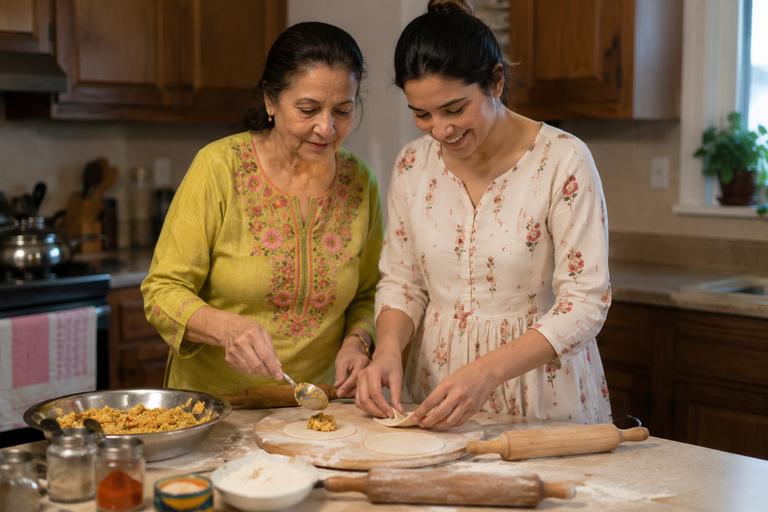
The Cultural Complexity of Migration
Migration changes the relationship between people and culture.
Practices that once felt ordinary may become symbols of identity in a new country. A holiday that required little explanation in one place may require careful teaching in another.
Families may begin preserving traditions more intentionally after leaving home because distance creates a new awareness of what can be lost.
Women may carry the emotional responsibility of maintaining continuity while also helping their families adapt.
They create familiar meals with unfamiliar ingredients.
They maintain celebrations within new work schedules and school calendars.
They help children understand customs that their classmates may not share.
They balance the desire to belong in the new country with the desire not to disappear inside it.
This balance can be difficult.
Children may reject traditions because they fear being perceived as different. Parents may interpret adaptation as abandonment. Women may feel responsible for protecting culture while also protecting their children from isolation.
There is no perfect formula.
Cultural identity can be layered.
A woman can belong fully to the country in which she lives while remaining deeply connected to the place from which her family came.
Belonging does not always require choosing only one home.
Tradition and the Right to Question
Not everything inherited should be preserved unchanged.
Culture contains beauty, wisdom, artistry, connection, and meaning. It can also contain expectations that limit women, silence pain, or protect inequality.
Women who preserve culture may also become the women who transform it.
They may continue the celebrations while rejecting the discrimination.
Preserve the language while challenging the silence.
Honor their elders while choosing different opportunities for their daughters.
Maintain spiritual traditions while questioning interpretations that deny women authority.
This is not necessarily a rejection of culture.
It may be a deeper form of responsibility.
A living culture must be able to examine itself.
Women should not be asked to protect traditions that require their suffering in order to survive.
Respect for heritage does not require obedience to every inherited rule.
A woman can love where she comes from and still demand that its future become more just.
Mothers as Cultural Educators
Motherhood often becomes one of the most important points of cultural transmission.
When a woman has children, questions of identity may become more urgent.
Which language should be spoken at home?
Which traditions should be celebrated?
What stories should the children know?
How should family values be explained within a changing world?
What should be preserved exactly, and what should be adapted?
These decisions carry emotional weight because mothers often feel responsible for what the next generation remembers.
But cultural education should not rest entirely upon women.
Fathers, schools, community institutions, religious organizations, artists, writers, and public leaders all share responsibility for cultural continuity.
When culture survives only through the unpaid labor of women, that labor can become overwhelming.
Women should be honored as cultural educators without being expected to carry the entire history of a community alone.
The Grandmother as a Living Archive
Grandmothers often possess forms of knowledge that cannot be found in official records.
They remember family relationships, migrations, losses, celebrations, local customs, and the meaning of objects others may overlook.
They know which stories were never written down.
They may remember a song that has disappeared from public life, a phrase no longer commonly spoken, or the name of a woman whose contribution was forgotten.
Listening to older women is therefore an act of cultural preservation.
Their memories should be recorded with permission and care.
Ask about childhood.
Ask what changed after marriage, migration, motherhood, war, or economic hardship.
Ask what women were permitted to do and what they did anyway.
Ask which traditions brought joy and which created pain.
Ask what they hope future generations will preserve.
The purpose is not to romanticize the past.
It is to understand it through the voices of those who lived within it.
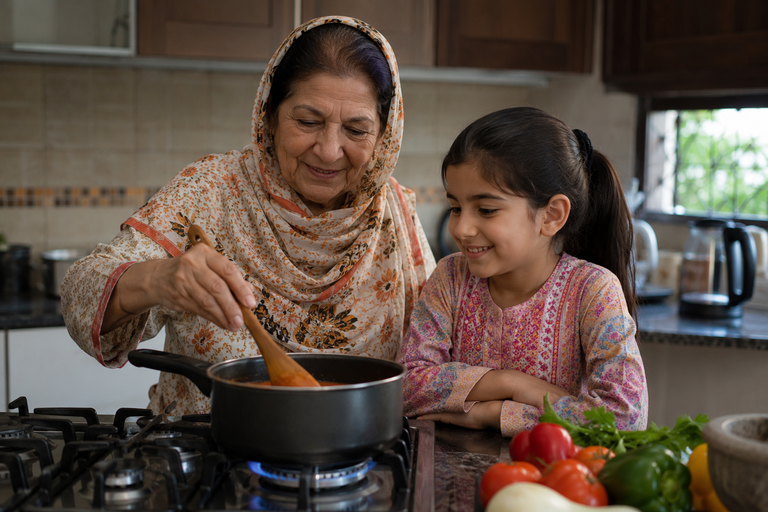
Cultural Memory Through Art
Women preserve culture not only through family practices, but also through art.
Writers preserve language and experience.
Photographers preserve faces, homes, rituals, and landscapes.
Filmmakers document stories that might otherwise disappear.
Designers reinterpret traditional forms.
Musicians revive songs, instruments, and rhythms.
Visual artists explore identity, migration, memory, and belonging.
Through art, private cultural experience becomes part of public memory.
An artist may transform a family story into a work that speaks to thousands of people. A photograph may preserve a disappearing tradition. A novel may document the emotional complexity of living between cultures.
Art allows culture to travel beyond its original setting.
It also gives women the authority to represent themselves rather than waiting for others to explain their lives.
Cultural Preservation in the Digital Age
Technology has created unprecedented opportunities to preserve culture.
Families can record oral histories using a phone.
Recipes can be archived with photographs and video.
Traditional music can be shared globally.
Digital publications can document artists, elders, business owners, community leaders, and ordinary women whose experiences deserve recognition.
But the digital age also creates new risks.
Information can be shared without context. Traditional designs can be copied without credit. Cultural practices can become trends detached from their origins. Images can travel widely while the people behind them remain invisible.
Preservation must therefore include attribution.
Who created the work?
Where did the tradition originate?
What does it mean?
Who benefits when it is commercialized?
Respectful cultural exchange requires curiosity and credit, not merely consumption.
The Difference Between Appreciation and Appropriation
Culture becomes richer through exchange.
Music, food, design, language, and ideas have always moved between communities.
But there is a difference between appreciation and appropriation.
Appreciation involves learning, acknowledgment, respect, and context.
Appropriation removes cultural elements from the people who created them, often turning sacred, historical, or meaningful symbols into temporary decoration.
Women in fashion, media, business, and art carry a special responsibility to understand this difference.
A traditional design should not be treated as an anonymous pattern.
A ceremonial garment should not become a costume without explanation.
A community’s craft should not be copied while its artisans remain uncompensated.
Cultural beauty should be celebrated in ways that preserve dignity and support the people who carry it.
Women Creating New Traditions
Not every meaningful tradition must be inherited.
Women also create traditions.
A mother may begin an annual family gathering that did not exist in her childhood.
A group of friends may create a ritual of supporting one another’s professional achievements.
A community may establish a celebration recognizing women whose work was previously overlooked.
A woman may create new ways of honoring birth, grief, marriage, aging, achievement, or transition.
New traditions become meaningful through repetition and intention.
They reflect the needs of contemporary life while creating continuity for the future.
Culture is therefore not only what women receive.
It is also what they design.
What We Choose to Carry Forward
Every generation makes decisions about inheritance.
Some traditions will continue.
Some will change.
Some will be restored after nearly disappearing.
Others will be released because they no longer reflect the dignity or values of the people expected to practice them.
The responsibility is not to preserve everything without question.
It is to preserve meaning.
To understand origins.
To protect stories.
To honor craftsmanship.
To remember the women whose labor made continuity possible.
A culture remains strong not when it refuses to change, but when it knows what is essential enough to carry forward.
The Women Who Keep Culture Alive
Women preserve culture through countless acts that rarely receive public recognition.
They teach.
Cook.
Translate.
Write.
Sing.
Design.
Photograph.
Organize.
Remember.
Question.
Reinvent.
They keep family stories from disappearing. They protect language from silence. They transform inherited traditions so daughters can live within them with greater freedom.
Their work connects memory with possibility.
Without them, history becomes thinner.
Identity becomes less certain.
The future becomes disconnected from the wisdom, beauty, and sacrifice that came before it.
Culture does not survive because it is old.
It survives because someone continues to give it life.
And across families, communities, and nations, women have always been among its most devoted guardians, courageous critics, and imaginative creators.