
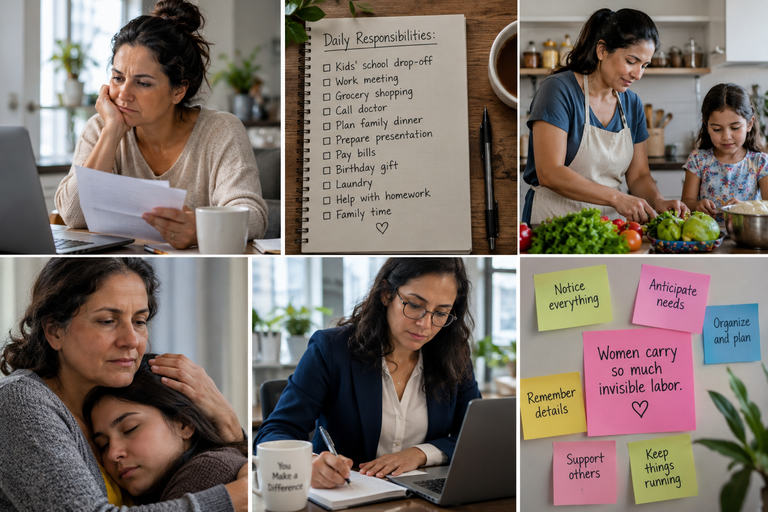
Women are often praised for holding everything together, yet the invisible labor required to anticipate, organize, remember, reassure, and care can quietly consume the woman carrying it.
There is a kind of work that rarely appears on a calendar.
It cannot always be measured in hours, assigned a salary, or explained through a formal job description. Yet it shapes homes, relationships, workplaces, families, and entire communities.
It is the work of remembering.
Anticipating.
Noticing.
Preparing.
Listening.
Adjusting.
A woman remembers the appointment no one else recorded. She notices the subtle change in a child’s behavior, the tension beneath a partner’s silence, the birthday approaching, the medication requiring renewal, the colleague who has become unusually withdrawn, and the family member who needs to be called before loneliness becomes hurt.
She may coordinate meals, schedules, emotions, celebrations, responsibilities, and expectations while continuing to meet professional demands with composure.
From the outside, life appears organized.
Inside, her mind may never become quiet.
This is the invisible architecture of emotional labor—the continuous effort required to manage not only what must be done, but also how everyone around her is feeling while it is being done.
Women are often celebrated for carrying this weight gracefully.
Far less often are they asked whether the weight should have been theirs alone.
The Work Beneath the Work
Visible labor is relatively easy to identify.
A meal is prepared. A meeting is completed. A child is driven to school. A household bill is paid. A family gathering takes place.
Invisible labor exists beneath those outcomes.
Before the meal, someone considered dietary needs, checked available ingredients, remembered preferences, planned timing, purchased supplies, and anticipated whether everyone would arrive hungry.
Before the meeting, someone may have prepared the agenda, remembered the sensitivities in the room, followed up with participants, and privately encouraged a colleague whose confidence was uncertain.
Before the child reaches school, someone has remembered the uniform, project deadline, lunch, permission slip, emotional concern, transportation arrangement, and the fact that Wednesday ends earlier than Tuesday.
The task itself may be shared.
The responsibility for remembering that the task exists often is not.
This distinction matters.
A person may appear to “help” while another person continues carrying the entire mental structure: identifying what is needed, explaining how to complete it, monitoring progress, and ensuring nothing is forgotten.
When women say they are tired, they may not be describing only physical fatigue.
They may be describing the exhaustion of remaining continuously responsible for what everyone else is permitted to forget.

The Woman Who Anticipates Everything
Anticipation is one of the least visible forms of care.
A woman prepares before a need becomes urgent.
She purchases the gift before the celebration. She notices the household item running low. She plans for the weather, the traffic, the child’s anxiety, the guest’s dietary restriction, and the possibility that the original plan may fail.
This foresight can appear effortless because its success is defined by what does not happen.
No one runs out of what was needed.
No appointment is missed.
No guest feels overlooked.
No crisis becomes visible.
Because the problem was prevented, the labor behind preventing it disappears.
Competence can therefore become a trap.
The more effectively a woman manages life, the more others may assume that life simply manages itself.
Her excellence hides the cost of her effort.
Eventually, she may become indispensable in ways that are neither fair nor sustainable.
Emotional Labor Is Not the Same as Kindness
Kindness is freely offered.
Emotional labor becomes burdensome when one person is expected to regulate the emotional environment for everyone else.
A woman may feel responsible for softening difficult truths, preserving harmony, remembering personal details, managing conflict, encouraging discouraged people, and ensuring that no one feels uncomfortable—even when she herself is exhausted or hurt.
She learns to deliver criticism gently so others will not become defensive.
She translates anger into language the family can tolerate.
She absorbs disappointment to protect an occasion.
She monitors her tone while others express themselves without restraint.
This labor can be valuable. Emotional intelligence strengthens relationships and institutions.
But emotional intelligence should not become a permanent obligation assigned primarily to women.
A woman should not have to become the emotional interpreter, peacekeeper, motivator, and caretaker in every room she enters.
She deserves relationships in which others also notice, initiate, repair, and respond.
Why Capable Women Are Given More
Responsibility often travels toward the person least likely to let something fail.
At home and at work, capable women may receive increasing amounts of labor precisely because they perform it well.
She is organized, so she is asked to coordinate.
She is compassionate, so she is expected to comfort.
She is reliable, so incomplete work eventually reaches her.
She is attentive, so everyone assumes she will notice what others ignore.
Over time, praise becomes another way of assigning responsibility.
“You are so good at this.”
“No one handles it like you.”
“You always know what to do.”
These statements may sound appreciative, but they can conceal an unfair structure.
Being skilled at carrying a burden does not mean a woman should continue carrying it alone.
Competence should create opportunity, not permanent overextension.
The Mother as Family Memory
Within families, mothers are often expected to become living archives.
They remember the details of childhoods, friendships, medical histories, school requirements, family traditions, clothing sizes, favorite foods, social conflicts, and emotional milestones.
They may also preserve the relationships connecting generations.
They call relatives, organize gatherings, remember anniversaries, send photographs, purchase gifts, and maintain the rituals through which a family continues to feel like a family.
When this work is not performed, the absence becomes visible.
Yet while it is being performed, it is frequently treated as natural rather than laborious.
A mother may deeply value creating family continuity. But meaningful work can still become exhausting when it is expected rather than shared.
Love does not eliminate the need for reciprocity.
A family should not depend upon one woman’s uninterrupted attention in order to remain emotionally connected.

Invisible Labor in the Workplace
The emotional work women perform is not confined to the home.
In professional settings, women are often expected to take notes, welcome new employees, organize celebrations, mentor junior colleagues, remember personal circumstances, ease tension, and maintain team morale.
Some of this work may never appear in a performance evaluation.
It may not lead to promotion, compensation, or greater authority.
Yet it helps organizations function.
A woman who creates a humane workplace contributes real value. The problem arises when relational labor becomes expected from her while strategic or highly visible assignments are given elsewhere.
Service should not become a substitute for advancement.
Women should be able to contribute warmth, collaboration, and emotional intelligence without being confined to roles that support everyone else’s success while leaving their own authority unchanged.
The Exhaustion of Being the Safe Person
Some women become the person everyone calls.
Friends bring their crises.
Family members bring their conflicts.
Colleagues bring their fears.
Children bring their confusion.
Partners bring the emotions they have not learned to process elsewhere.
Being trusted is meaningful.
It can also become overwhelming.
A woman may begin every conversation by asking how someone else is doing while no one asks the same question with genuine attention.
She listens patiently but edits her own difficulties because there seems to be no room for them.
She becomes known as strong, and strength gradually becomes a role she is not allowed to leave.
The safe person also needs safety.
The listener also needs to be heard.
The woman who holds others also needs relationships in which she can set down what she carries.
Resentment Is Often a Signal
Resentment is frequently treated as a personal failure.
A woman may criticize herself for feeling irritated by people she loves or exhausted by responsibilities she once accepted willingly.
But resentment often contains information.
It may indicate that giving has continued beyond capacity.
That a boundary was needed but never expressed.
That support was expected but did not arrive.
That responsibility became unequal.
That appreciation was offered in words while the structure remained unchanged.
Resentment does not automatically mean love has disappeared.
It may mean love has been asked to survive under conditions that are no longer sustainable.
Rather than suppressing resentment through guilt, a woman can examine what it is attempting to communicate.
What am I carrying that should be shared?
Where am I saying yes while privately wishing I had said no?
Which responsibilities have become mine only because I never stopped performing them?
What support have I needed but never clearly requested?
Honesty may initially disrupt harmony.
But harmony built upon one woman’s silent depletion is not true peace.
Asking Is Not the Same as Sharing
Women are often advised simply to ask for help.
This can be useful, but it does not fully address the imbalance.
When a woman must identify every need, assign every task, explain each detail, remind the person responsible, and check whether it was completed, she remains the manager of the entire system.
The physical task may be delegated.
The mental labor has not been shared.
True partnership requires initiative.
It means noticing without being instructed.
Remembering without being reminded.
Completing without being supervised.
Taking ownership of an area of responsibility from beginning to end.
A household, team, or relationship becomes more equitable when responsibility is not framed as one person’s work and everyone else’s assistance.
Adults do not help one another manage a shared life.
They participate in managing it.
The Difficulty of Letting Others Do It Differently
Women who have carried responsibility for a long time may struggle to release it.
This is understandable.
When consequences have repeatedly fallen upon her, control may have become a form of protection.
She knows the details.
She understands the standards.
She has learned that if she does not follow through, something important may be missed.
Sharing responsibility therefore requires more than assigning tasks.
It may require accepting that another capable person will complete them differently.
Not carelessly.
Differently.
If a woman corrects every alternative method, redoes every completed task, or maintains absolute control over every detail, others may eventually stop participating.
This does not mean she must accept neglect or poor effort.
It means distinguishing between what truly matters and what merely reflects personal preference.
Shared responsibility requires shared authority.

The Performance of “Having It All”
Modern women are often encouraged to pursue every dimension of life simultaneously and beautifully.
Build the career.
Raise the family.
Maintain the relationship.
Protect personal health.
Remain socially connected.
Create a beautiful home.
Stay informed.
Remain attractive.
Be emotionally available.
Continue growing.
The promise appears empowering: women can have it all.
The hidden message is less generous: women should manage it all without allowing the effort to become visible.
This expectation turns ordinary human limitation into private shame.
A woman may believe she is failing because she cannot sustain a standard no person was meant to sustain alone.
The question should not be whether women can do everything.
Many women already do an extraordinary amount.
The more important question is why so much depends upon their ability to endure.
Rest Is Not Enough When the Structure Remains the Same
Rest is essential, but rest alone cannot resolve an unequal system.
A weekend away may temporarily restore energy. A spa appointment, quiet evening, or uninterrupted morning may offer relief.
But when a woman returns to the same concentration of responsibility, exhaustion begins rebuilding immediately.
Self-care should not become a decorative solution to structural imbalance.
A bath cannot compensate for a partner who refuses to participate.
A vacation cannot repair a workplace that rewards endless availability.
A meditation practice cannot eliminate the burden of being solely responsible for an entire family’s emotional and logistical functioning.
Women deserve restorative practices.
They also deserve practical change.
Sometimes wellbeing requires not becoming better at carrying the load, but reducing the load itself.
The Language of Redistribution
Changing invisible labor begins with making it visible.
Vague expressions such as “I need more help” may lead to temporary gestures without lasting change.
Specific language creates greater clarity:
“I am currently managing all medical appointments. I need you to take full responsibility for scheduling and attending these appointments.”
“I do not want to remind you about this task. I need you to own it from beginning to completion.”
“I cannot continue being the only person who maintains contact with both sides of the family.”
“I am available to listen, but I do not have the emotional capacity for a long conversation tonight.”
“This project includes coordination and follow-up that are not reflected in my role. We need to discuss workload and recognition.”
The purpose is not to assign blame.
It is to describe reality accurately enough that it can be changed.
Teaching Children to Notice
Families can interrupt unequal patterns by teaching children that care is a shared human responsibility.
Children can learn to notice what needs to be done, contribute according to age, remember commitments, apologize, prepare, and participate in maintaining family life.
Boys should not grow up believing that domestic and emotional labor naturally belongs to women.
Girls should not be praised primarily for being helpful, mature, or accommodating while boys are excused from the same expectations.
Every child benefits from learning practical competence and emotional awareness.
A child who learns to contribute does not lose childhood.
That child gains the ability to become a responsible adult who does not depend upon someone else’s invisible labor.
Releasing the Need to Be Indispensable
Being needed can provide a sense of identity.
A woman may feel valuable because others depend upon her. She may fear that if she stops doing everything, she will become less important or less loved.
But indispensability is a dangerous form of security.
It requires continuous overfunctioning.
A relationship that depends upon one person’s exhaustion is not proof of that person’s value.
A woman should be loved for more than what she organizes, provides, remembers, and repairs.
She is not valuable because nothing functions without her.
She is valuable because she is a person whose presence, ideas, character, and inner life matter independently of her usefulness.

Receiving Without Repayment
Some women are comfortable giving but uneasy receiving.
A kind gesture creates immediate pressure to return it.
Support produces guilt.
Rest feels undeserved.
Allowing another person to take responsibility can feel like burdening them.
But reciprocity does not require every act to be repaid immediately.
Healthy relationships contain seasons.
Sometimes one person gives more. At another time, the balance changes.
Receiving is not exploitation when it exists within mutual care.
It is trust.
A woman who allows others to support her gives them the opportunity to participate meaningfully in the relationship.
She no longer protects everyone from the experience of being responsible for her too.
A More Humane Definition of Strength
Strength is frequently defined as endurance.
The strong woman continues.
She handles the crisis.
She absorbs the pressure.
She finds a solution.
But endurance is only one form of strength.
Strength can also mean stopping.
Delegating.
Naming unfairness.
Requesting support.
Allowing disappointment.
Admitting uncertainty.
Refusing an expectation that has become destructive.
The strongest decision may not be the one that preserves appearances.
It may be the one that protects the woman beneath them.
What Equitable Care Looks Like
Equitable care does not mean every responsibility is divided perfectly at every moment.
Life changes.
One person may have greater capacity during a particular season. Illness, work pressure, pregnancy, caregiving, grief, and financial circumstances may temporarily alter what each person can contribute.
Equity is found in awareness, communication, and willingness.
Everyone understands what must be carried.
No one assumes that one woman will silently absorb what remains.
Contributions are respected even when they take different forms.
The arrangement can be discussed and revised.
Care moves in more than one direction.
The goal is not mathematical precision.
It is mutual responsibility.
Let Her Put Something Down
Women have carried families, organizations, communities, traditions, and relationships with extraordinary devotion.
That work deserves recognition.
But recognition without redistribution is insufficient.
A woman does not need another compliment for being strong while the conditions exhausting her remain unchanged.
She needs time that belongs to her.
Responsibilities that are genuinely shared.
Relationships in which her needs are noticed.
Workplaces that recognize emotional and organizational labor.
Families that do not depend upon her depletion.
She needs permission—not from the world, but from herself—to put something down.
Not because she has stopped caring.
Because care should not require disappearance.
The weight no one sees is still weight.
And a woman should not have to collapse before others finally understand that she was carrying too much.